Game Design
Loot Boxes - Hidden Gambling Mechanics in Video Games
There is a box with something inside, it might be something kind of awesome then again it might not. How much would you pay to find out?
Read storyThe one thing all good or bad games have in common - a player (with personal preferences). Wouldn't it be neat to design a game that is custom tailor for a player's personality?
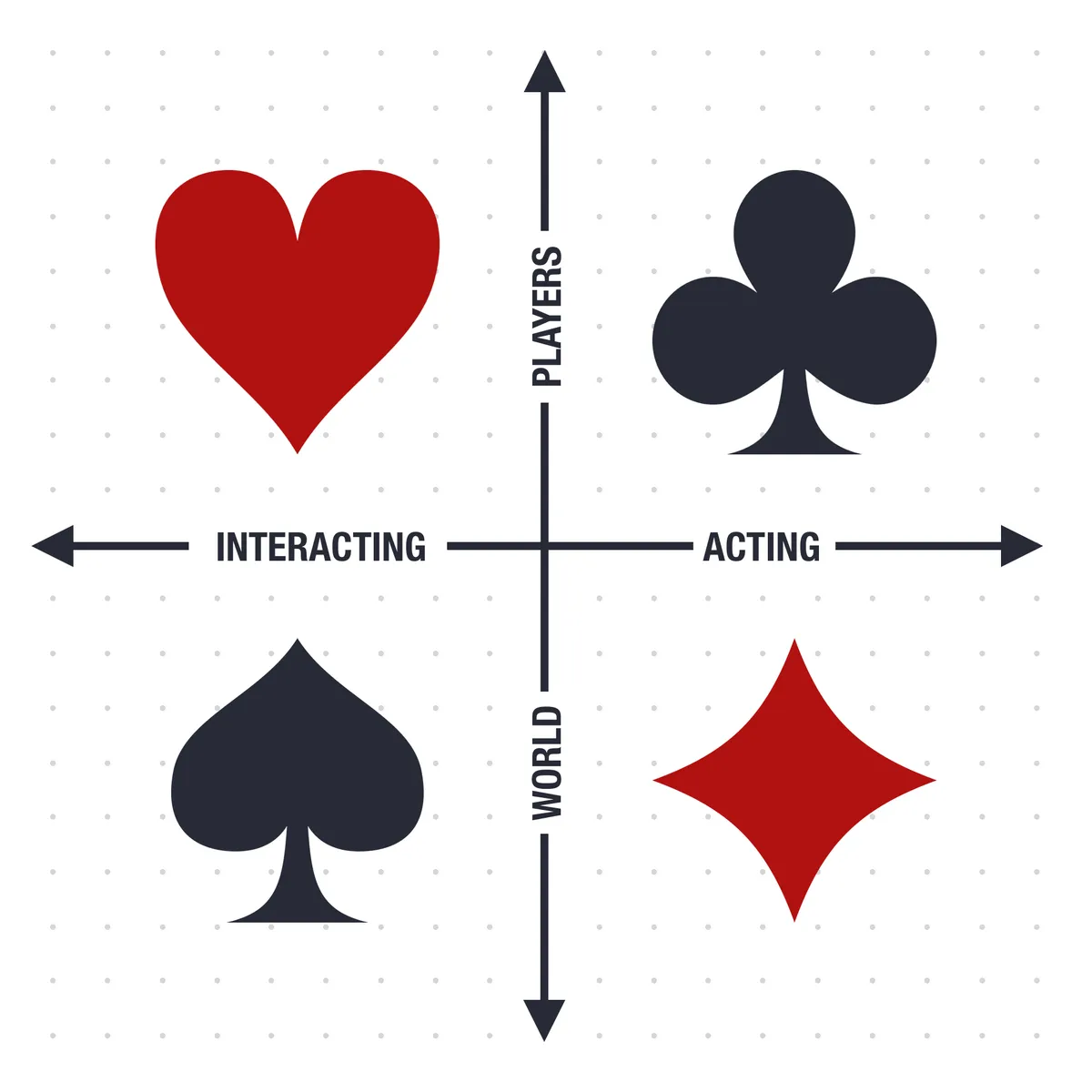
Richard Bartle’s Four Player Types is probably one most simplistic gamer psychology that works.
His approach arises from the inter-relationship of two-dimension of playing style: acting versus interacting, and world-oriented versus player-oriented, generating four different kings of playstyle interests. Each of which is presented with a descriptive name:
Frankly, these types are associated with French-suited cards (a.k.a. the regular playing cards), where:
You can find Richard Bartles official report here: “HEARTS, CLUBS, DIAMONDS, SPADES: PLAYERS WHO SUIT MUDS”
These kinds of playstyle traits help you learn why some people like “Counter-Strike” (Killers, Achievers) and others “Animal Crossing: New Horizons” (Explorers, Socializers). And mostly how they are interacting with the game elements. Both games have a chat function: in Counter-Strike it serves as tactical information and personal humiliation channel, but in Animal Crossing: New Horizons it’s used for being a hospitable island host.
Let’s say you have a task to improve the in-game cross-player interaction elements. You wouldn’t put the “Revenge Now” button in Animal Crossing: New Horizons next to the island guests profile. Or the “Send resources as a present to all guests” option in the “Counter-Strike” game by giving your opponent the upper hand in the upcoming deathmatch.

Written by EdgeLimits
There is a box with something inside, it might be something kind of awesome then again it might not. How much would you pay to find out?
Read storyAnd, how games can exploit human weaknesses towards making money?
Read storyMost of the time, a game with a single gameplay loop isn't enough to ensure that it has endless playability.
Read story